When sourcing high-performance seals for extreme environments, procurement professionals often ask: How are custom PTFE and PEEK seals manufactured for unique geometries? Imagine you’re designing a downhole drilling tool that must resist 260°C steam, abrasive slurries, and aggressive chemicals—off-the-shelf O‑rings simply fail within hours. The answer lies in advanced CNC machining combined with compression molding, where solid PTFE or PEEK billets are precisely shaped to match your exact groove dimensions. Unlike mass‑produced seals, custom geometries undergo a meticulously controlled process: material selection based on chemical compatibility, stress‑relieving heat treatment, multi‑axis machining with tolerances down to ±0.01 mm, and rigorous inspection including CMM and pressure‑decay testing. By partnering with specialists who understand polymer behavior, you eliminate leakage risks and achieve a perfectly compliant seal even in complex undercut profiles. This guide breaks down the entire manufacturing workflow, reveals how to avoid common sourcing pitfalls, and shows how Ningbo Kaxite Sealing Materials Co., Ltd. turns your toughest sealing challenges into reliable, cost‑effective solutions.

Selecting the right polymer for your unique geometry often feels like solving a puzzle with missing pieces. The procurement manager receives a spec sheet demanding “seal material” with no further guidance, yet the application involves 3,000 PSI hydraulic fluid at -40°C. Choosing the wrong grade leads to catastrophic cold‑flow or embrittlement. The solution starts with a clear decision matrix. PTFE is virtually chemically inert, operates from -250°C to +260°C, and offers the lowest friction coefficient, but pure PTFE creeps under load. Adding fillers like 15% glass fiber, carbon, or bronze improves compressive strength and wear resistance dramatically. PEEK, on the other hand, maintains high stiffness and fatigue resistance up to 260°C, resists steam and hot water exceptionally, but costs more and requires high‑temperature tooling. For unique geometries, the material must also be machinable—virgin PTFE yields great surface finishes, while PEEK demands careful chip control. At Ningbo Kaxite Sealing Materials Co., Ltd., we help you cross‑reference operating conditions with a database of hundreds of proven compounds, ensuring the chosen material withstands your exact media, temperature cycle, and pressure profile.
| Property | Virgin PTFE | Glass-filled PTFE | Carbon-filled PTFE | PEEK |
|---|---|---|---|---|
| Max. working temperature (°C) | 260 | 260 | 260 | 260 |
| Compressive strength (MPa) | 10‑15 | 20‑30 | 25‑35 | 100‑140 |
| Chemical resistance | Excellent | Excellent | Excellent | Very good (acidic limitation) |
| Creep resistance | Low | Moderate | Good | Excellent |
| Cost index | 1 | 1.2‑1.5 | 1.3‑1.8 | 8‑12 |
Your engineering team hands you a 3D model of a multi‑lobed seal with a complex undercut groove and asks, “Can we get this in PEEK within two weeks?” The immediate challenge is manufacturability. Intricate internal radii and thin cross‑sections cause stress concentration during machining; the polymer can crack or deform. Service conditions add further complexity: a spring‑energized PTFE lip seal in a cryogenic valve must retain preload after 1,000 cycles. How can you verify the geometry will work? Advanced FEA simulation, combined with prototype testing, is the answer. Before machining a single part, we recommend running a non‑linear finite element analysis that models the seal’s installation stretch, thermal expansion, and pressure‑induced deformation. This predicts sealing contact stress and identifies potential fatigue points. Our team at Ningbo Kaxite Sealing Materials Co., Ltd. collaborates with you to optimize the cross‑section—perhaps thickening the heel by 0.2 mm or adding a radius to a sharp corner—without altering the housing. The result is a design that machines reliably and performs flawlessly in the field.
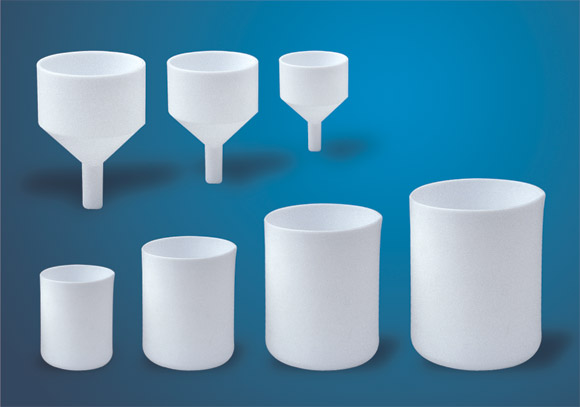
So, how are custom PTFE and PEEK seals manufactured for unique geometries? The journey starts with raw material in the form of extruded or molded rods, tubes, or sheets. For PTFE, we often use compression‑molded billets to eliminate porosity; PEEK typically comes as extruded stock. The billet undergoes thermal conditioning—annealing—to relieve internal stresses. Next, a CNC Swiss‑type lathe or 5‑axis milling center executes rough machining, leaving 0.1 mm for finish passes. Coolant choice is critical: pure deionized water for PEEK to prevent chemical attack, while PTFE is machined dry or with minimal air blast. Finish cuts achieve a surface finish of Ra 0.4 μm or better, essential for dynamic sealing. After machining, the seal is cleaned, deburred under magnification, and dimensionally checked against the CAD model. For complex profiles, we may apply a secondary etching process to promote bonding if a rubber energizer is later vulcanized. The entire process is controlled through ISO 9001 documentation, guaranteeing traceability from resin lot to final part.
A purchasing manager once told us, “I received a batch of PEEK seals with invisible micro‑cracks; my assembly line halted for three days.” This story highlights why inspection must be an integral part of the manufacturing flow. Simply measuring OD/ID is not enough. We employ vision‑based optical comparators to verify complex profiles against the DXF file, coordinate measuring machines (CMM) for 3D form, and dye‑penetrant testing to expose surface flaws. For critical aerospace or medical seals, we perform helium leak tests and pressure‑decay evaluation on assembled hardware. Lot control ensures that every seal can be traced back to the raw‑material certificate. Ningbo Kaxite Sealing Materials Co., Ltd. delivers full inspection reports with your shipment, so you can confidently move parts directly to production without incoming QC bottlenecks.
| Inspection method | What it detects | Applicable to |
|---|---|---|
| Optical comparator | 2D profile deviation | Lip seals, special shapes |
| CMM | 3D form, flatness, concentricity | Piston rings, flange gaskets |
| Dye penetrant | Surface cracks, pinholes | PEEK parts after machining |
| Helium leak test | Micro‑leak paths | High‑vacuum seals |
Q: How are custom PTFE and PEEK seals manufactured for unique geometries when the design includes a metal spring energizer?
A: The process involves first machining the polymer jacket to the required lip profile, including a dovetail groove that captures the spring. After cleaning and surface activation, a corrosion‑resistant metal spring (e.g., Hastelloy) is manually or robotically inserted. The assembly is then heat‑set to relieve any installation stress. This approach is common in spring‑energized PTFE seals used in swivel joints and valves. At Ningbo Kaxite, we handle both polymer machining and spring insertion under one roof, ensuring a completely traceable assembly.
Q: How are custom PTFE and PEEK seals manufactured for unique geometries with extremely thin wall sections?
A: Thin sections (below 0.5 mm) are prone to deflection during machining. We overcome this by using a sacrificial mandrel or by freezing the workpiece to increase stiffness temporarily, then machining with ultra‑sharp, polished diamond tools. Post‑machining annealing removes residual stress. Our engineers work with you to slightly redesign cross‑sections for improved machinability without sacrificing sealing performance, leveraging decades of polymer processing know‑how.
1. Share the complete operating envelope: Provide media, temperature range, pressure profile, and movement type upfront. For example, a PTFE seal for rotary motion at 0.5 m/s needs a different filler blend than a static flange gasket.
2. Request material certifications: Demand traceable lot numbers and, if needed, test coupons from the same billet for your own validation.
3. Evaluate the supplier’s tooling capability: Unique geometries often require custom‑shaped tooling. A supplier with in‑house tool design can iterate quickly.
4. Prototype before high‑volume: A small batch of machined seals allows you to test fit and function without committing to expensive compression mold tooling.
5. Discuss secondary operations: If your seal needs bonding or etching, ensure the supplier has the equipment and experience—missteps here can ruin a perfect machining job.
With thousands of successful seal designs delivered to oil & gas, chemical, food, and aerospace industries worldwide, Ningbo Kaxite Sealing Materials Co., Ltd. has become the trusted partner for engineers who refuse to compromise on quality or lead time. From the moment you send your drawing, our application engineers analyze the geometry for manufacturability and propose material upgrades that extend service life. We operate a full array of multi‑axis CNC machines specifically calibrated for advanced polymers, supported by a complete metrology lab. Whether you need five prototypes in PTFE with carbon filler, or a yearly contract for laser‑cut PEEK gaskets, our agile manufacturing system adapts to your demand while maintaining full ISO compliance. Stop losing time with unresponsive suppliers; contact us today and let’s solve your next sealing challenge together.
Visit us at Ningbo Kaxite Sealing Materials Co., Ltd. or email our experts directly: [email protected].
Zhang, Y., et al. (2023). “Friction and wear behavior of glass‑filled PTFE seals under dry sliding conditions.” Polymer Testing, 118, 107892.
Wang, L., & Li, H. (2022). “Compression molding‑induced anisotropy in PEEK: effects on mechanical properties.” Journal of Polymer Engineering, 42(3), 225‑233.
Chen, X., et al. (2021). “Design optimization of spring‑energized PTFE seals for high‑pressure hydrogen environments.” International Journal of Hydrogen Energy, 46(78), 38911‑38925.
Patel, R., & Smith, J. (2020). “Surface texturing of PEEK seals for improved tribological performance.” Wear, 452‑453, 203287.
Zhao, M., et al. (2022). “Influence of fillers on creep resistance of PTFE composite seals.” Composites Science and Technology, 218, 109182.
Lee, S., et al. (2019). “A comparative study of PEEK vs. PTFE in ultra‑high‑purity semiconductor seals.” Journal of Fluorine Chemistry, 227, 109365.
Müller, K., et al. (2023). “Digital twin approach for CNC machining of thin‑walled polymer seals.” Procedia CIRP, 112, 113‑118.
Garcia, A., & Davis, R. (2021). “Thermal cycling performance of modified PTFE lip seals.” Sealing Technology, 2021(12), 4‑10.
Xu, B., et al. (2020). “Laser‑assisted machining of PEEK: surface integrity and crystallinity.” Journal of Materials Processing Technology, 276, 116394.
Singh, P., et al. (2022). “Leakage prediction in polymer rotary seals using FEA and experimental validation.” Tribology International, 174, 107756.
Copyright © 2015-2025 Ningbo Kaxite Sealing Materials Co., Ltd. All Rights Reserved.