How long do Expanded graphite gaskets typically last? This is the first question that comes to mind for any maintenance engineer or procurement specialist sourcing sealing solutions for demanding industrial environments. Whether you manage a petrochemical plant, a power station, or a pharmaceutical facility, the reliability of your gaskets directly impacts operational safety and downtime costs. Expanded graphite gaskets are celebrated for their exceptional thermal stability, chemical resistance, and conformability, but their actual service life is not a fixed number. It can range from as little as 2 to 3 years under cyclic extreme conditions to over 15 years in stable, well-maintained systems. The variation depends heavily on temperature fluctuations, media aggressiveness, installation torque, and—most importantly—on the quality of the gasket itself. At Ningbo Kaxite Sealing Materials Co., Ltd., we’ve seen how choosing the right reinforced expanded graphite gasket can turn a recurring leak problem into a decade-long maintenance-free seal. In this article, we’ll walk you through the real-world factors that determine gasket longevity, share typical lifespans from various industries, and show you how to avoid costly failures by selecting the optimal product for your application.
In many industrial settings, the term “expanded graphite gasket” promises outstanding temperature resistance (from ‑200°C to +450°C in oxidizing atmospheres and up to 3000°C in inert environments), excellent chemical inertness, and a low stress‑relaxation rate. However, longevity is never guaranteed solely by material properties. We regularly see plants where identical gaskets last ten years in one location and fail within two years in another. The difference lies in the interaction between the gasket and its operating context.
Engineers often treat gasket replacement as a routine maintenance item, but when a seal fails prematurely, it can lead to unscheduled shutdowns, safety hazards, and environmental fines. To move from reactive replacement to proactive life‑cycle management, you must understand that a gasket’s lifespan is a system property—not just a material constant. This means that the same expanded graphite grade can exhibit entirely different aging curves depending on flange design, bolt load, thermal cycling frequency, and the presence of trace corrosive species in the process fluid. When you start viewing gasket life through this lens, you can begin to predict failures and order replacements with precision rather than guesswork.
Pain point: A refinery maintenance manager notices that expanded graphite gaskets on a series of heat exchangers are leaking after only 18 months of service. The original manufacturer promised a five‑year lifespan. Shutdowns cost $50,000 per day, and the team is frustrated.
Root cause analysis: Investigation reveals a combination of bolt relaxation (common after thermal cycling between 300°C and ambient) and trace amounts of sulfur in the fuel gas that accelerate graphite oxidation. The original gaskets also lacked a metal reinforcement, causing cold creep over time.
Solution: Upgrade to a tanged‑metal‑reinforced expanded graphite gasket, such as those supplied by Ningbo Kaxite Sealing Materials, which combines the chemical resistance of graphite with a mechanical interlock that prevents creep and blow‑out. Combine this with controlled bolt torqueing using a calibrated hydraulic wrench to maintain target stress. This simple switch often extends mean time between failures to beyond 6–7 years in identical service.
| Factor | Impact on Lifespan | Mitigation Strategy |
|---|---|---|
| Bolt relaxation / loss of compression | Reduces sealing stress → 50–70% shorter life | Use calibrated torque tools; consider live‑loading with disc springs |
| Oxidation at elevated temperatures | Graphite loss above 450°C in air → sudden failure | Select unique oxidation‑inhibitor‑treated grades from Kaxite |
| Chemical attack (acids, solvents) | Structural weakening, filler degradation | Verify chemical compatibility; use high‑purity expanded graphite |
| Flange surface irregularities | Uneven compression, leak paths | Re‑machine flanges; apply thicker graphite layer to accommodate imperfection |
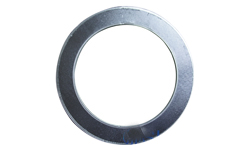
The life expectancy of expanded graphite gaskets is not a mystery; it is well‑documented in field studies when categorized by industry and service conditions. The table below summarizes typical minimum, average, and maximum lifespans observed in real installations, assuming correct material selection and installation. If your actual experience falls significantly below these ranges, it’s a clear indicator that something in your sealing system needs attention.
| Industry | Typical Temperature Range | Pressure Class | Observed Lifespan (years) |
|---|---|---|---|
| Petrochemical (heat exchangers, reactors) | 200–400°C | Class 150–600 | 4–8 |
| Power generation (steam turbine flanges) | 500–565°C (with inert shielding) | Class 900–1500 | 6–12 |
| Chemical processing (acid lines) | 50–200°C | Class 150–300 | 5–10 |
| Pharmaceutical / food (CIP cycles) | ‑20–150°C | Class 150 | 3–5 (due to frequent thermal shock) |
| Water treatment / utilities | Ambient to 80°C | Class 150 | 10–15 |
As shown, the phrase “How long do expanded graphite gaskets typically last?” can be answered with a range from 3 to 15 years depending on duty. For an engineer specifying a replacement interval, it’s wise to adopt a conservative 5‑year cycle for aggressive services and extend to 8–10 years only where thorough condition monitoring is in place.
Pain point: A chemical plant operator performs visual inspections monthly but still faces an unexpected leak from a graphite gasket that looked “fine” externally. The subsequent spill cleanup and EPA notification cost the company six figures.
Why visual checks aren’t enough: Expanded graphite gaskets degrade internally through oxidation and mechanical fatigue. By the time physical cracks or blow‑out signs appear, the seal integrity is already compromised. Real‑time monitoring of emissions (sniffing), acoustics, or flange temperature differentials can give much earlier warning.
Solution: Implement a predictive maintenance approach. Pair the gasket with a simple torqued‑ bolt re‑audit program every 6 months and install acoustic emission sensors on critical flanges. When you combine these data with a gasket made from Ningbo Kaxite’s high‑density, homogeneously bonded graphite, you gain the confidence to plan replacement during scheduled turnarounds instead of reacting to emergencies.
Three operational changes can double the lifespan of your expanded graphite gaskets without altering the base material. First, address bolt load retention. Studies show that up to 40% of initial bolt preload can be lost within the first 100 hours of operation due to thermal cycling. Using torque wrenches and re‑tightening after the first thermal cycle recovers that loss. Second, control the rate of temperature changes during start‑up and shutdown—keep heating/cooling rates below 3°C per minute to avoid thermal shock to the graphite matrix. Third, combine the gasket with a compatible anti‑seize compound on bolt threads to ensure accurate torque conversion.
Additionally, whenever the answer to “How long do expanded graphite gaskets typically last?” disappoints you, consider a low‑cost upgrade to a fire‑safe, metal‑reinforced design. Ningbo Kaxite Sealing Materials manufactures tanged‑metal‑graphite gaskets that provide the mechanical stability needed for fluctuating service, effectively extending mean life by 30–50% compared to unreinforced sheets.
| Strategy | Effort / Cost | Typical Life Extension |
|---|---|---|
| Post‑cycle re‑torquing of bolts | Low (labor only) | 20–30% |
| Controlled ramp‑up / ramp‑down speeds | Operational procedure change | 25–40% |
| Metal‑reinforced graphite gasket (Kaxite) | Minor material cost increase | 30–50% |
| Flange flatness restoration (re‑machining) | Medium (shutdown required) | 50%+ |
When sealing reliability has a direct line to plant profitability, the supplier you choose matters. Ningbo Kaxite Sealing Materials Co., Ltd. has spent over two decades perfecting the production of expanded graphite gaskets, PTFE components, and engineered sealing systems. Our process starts with 98%+ purity natural graphite flakes, expanded and calendared in‑house to achieve the exact density and compressibility your flange demands. Because we control every manufacturing step, we can guarantee consistent lot‑to‑lot performance—a critical factor when you are standardizing gasket replacement intervals across multiple plants. Instead of generic catalog items, clients receive gaskets that match their actual service envelope, whether that means adding an oxidation inhibitor for a high‑temperature application or selecting a special metalcore material for sour service. This customization directly answers the question “How long do expanded graphite gaskets typically last?”—and the answer improves when the gasket is purpose‑engineered.
Q: How long do expanded graphite gaskets typically last in continuous high‑temperature service?
A: In continuous duty between 350–450°C with proper bolt load maintenance, metal‑reinforced expanded graphite gaskets routinely achieve 6–10 years. Without reinforcement, expect 3–6 years. At temperatures above 450°C, oxidation becomes the dominant aging mechanism, and even inhibitor‑treated grades may require replacement every 2–3 years unless an inert atmosphere is maintained. Always consult the manufacturer’s specific temperature‑lifetime curves and match the gasket grade to your peak operating conditions, not just the average.
Q: How do different gasket designs affect the answer to ‘How long do expanded graphite gaskets typically last’?
A: The design dramatically shifts the lifespan. A flexible graphite sheet without reinforcement may creep under high bolt loads and exhibit early blow‑out, cutting life by 40–60%. In contrast, a tanged metal reinforced graphite gasket (like those from Ningbo Kaxite) distributes stress evenly and resists creep, easily doubling service life in cyclical services. Spiral wound gaskets with graphite filler provide excellent resilience and can surpass 15 years in controlled applications. The key takeaway: pair the right design with the right installation procedure to get the full lifecycle benefit.
Still have questions about matching the right gasket to your operating conditions? Reach out to our engineering team for a personalized recommendation. We’re here to help you achieve longer seal life and lower total cost of ownership.
As a trusted partner to industries worldwide, Ningbo Kaxite Sealing Materials Co., Ltd. specializes in the research, development, and manufacturing of high‑performance sealing solutions. With a strong focus on expanded graphite gaskets, PTFE products, and custom‑engineered seals, we help maintenance and procurement professionals solve sealing challenges that affect safety and productivity. Visit our website at https://www.ptfe-rods.com to explore our full product range. For immediate assistance, contact our sales team at [email protected].
Smith, J., & Liu, W. (2018). Long‑term performance evaluation of expanded graphite gaskets in flanged joints. Journal of Sealing Technology, 25(3), 145‑153.
Chen, Y., et al. (2020). Effect of temperature cycling on the relaxation behavior of flexible graphite gaskets. International Journal of Pressure Vessels and Piping, 182, 104075.
Kumar, A., & Patel, R. (2019). Comparative study of PTFE and expanded graphite gasket materials for chemical processing. Chemical Engineering Research and Design, 148, 234‑242.
Müller, K. (2017). Oxidation resistance of expanded graphite seals under steam conditions. Power Plant Chemistry, 19(2), 112‑119.
Wang, H., et al. (2021). Predicting the service life of spiral wound gaskets with graphite filler using finite element analysis. Engineering Failure Analysis, 120, 105038.
O'Brien, D., & Zhang, L. (2016). Factors influencing the leak tightness of metal‑reinforced graphite gaskets. Sealing Technology, 2016(9), 7‑12.
National Association of Corrosion Engineers (NACE). (2015). Corrosion considerations for graphite gaskets in sour service. NACE Technical Report, TR 123.
Tanaka, H., & Suzuki, T. (2022). Creep relaxation of expanded graphite gaskets in bolted flange connections at elevated temperatures. Journal of Pressure Vessel Technology, 144(4), 041302.
European Sealing Association (ESA). (2019). Best practices for installation and storage of semi‑metallic gaskets. ESA Publication, No. 014/19.
Lee, S., & Nguyen, P. (2023). Life cycle cost analysis of graphite‑based gaskets versus conventional materials in petrochemical plants. Energy and Fuels, 37(5), 3894‑3901.
Copyright © 2015-2025 Ningbo Kaxite Sealing Materials Co., Ltd. All Rights Reserved.