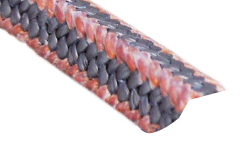
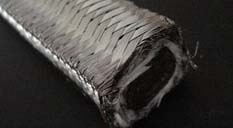
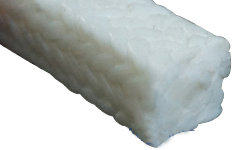
In the demanding world of industrial sealing and filtration, material selection is paramount. For over two decades, industry leaders have turned to a singular material for its unmatched combination of chemical inertness, thermal stability, and mechanical strength: PTFE Fiber. At Kaxite Sealing, we have dedicated ourselves to mastering the production and application of this extraordinary polymer, engineering it into high-performance sealing solutions that stand up to the most extreme conditions. PTFE Fiber is not just a material; it's a cornerstone of reliability in sectors ranging from chemical processing and pharmaceuticals to food and beverage and aerospace.
Polytetrafluoroethylene fiber is produced through a complex process of spinning and sintering, resulting in a multifilament yarn with exceptional properties. Unlike traditional materials, PTFE Fiber maintains its integrity across a vast temperature spectrum, exhibits near-universal chemical resistance, and possesses a naturally low coefficient of friction. When woven, braided, or needled into packings, gaskets, or filter media, it delivers sustained performance where others fail. Kaxite Sealing leverages advanced manufacturing techniques to ensure our PTFE Fiber products offer consistent quality, dimensional stability, and longevity, providing our clients with a definitive edge in operational efficiency and safety.
Understanding the technical specifications of PTFE Fiber is crucial for proper application engineering. Below are the core parameters that define Kaxite Sealing's premium fiber products.
| Property | Typical Value / Range | Test Method / Notes |
|---|---|---|
| Continuous Service Temperature | -260°C to +260°C (-436°F to +500°F) | Short-term peaks up to 288°C (550°F) possible |
| Tensile Strength | 1.5 - 3.5 GPa (for high-tenacity grades) | ASTM D2256 |
| Elongation at Break | 10% - 25% | ASTM D2256 |
| Melting Point | 327°C (621°F) | Does not flow; sintered structure |
| Coefficient of Friction | 0.05 - 0.10 (dynamic, fiber on metal) | Exceptionally low, self-lubricating |
| Chemical Resistance | Resistant to virtually all industrial chemicals and solvents | Attacked only by molten alkali metals and certain fluorine compounds at high T/p |
| Dielectric Strength | >40 kV/mm | Excellent electrical insulator |
| Flammability | Non-flammable (LOI >95%) | ASTM D2863; will not support combustion |
The unique property profile of our PTFE Fiber makes it the material of choice for numerous critical applications:
Q: What is the primary advantage of PTFE Fiber over other high-performance fibers like aramid or carbon fiber in sealing applications?
A: The definitive advantage is its universal chemical inertness combined with a wide temperature range. While aramid fibers degrade in strong acids or bases, and carbon fiber can be oxidized, PTFE Fiber is virtually unaffected by almost all chemicals from cryogenic temperatures up to 260°C. Its inherent lubricity also reduces wear on mating surfaces like pump shafts, a critical factor for packing longevity.
Q: Can Kaxite Sealing PTFE Fiber be used in food contact applications?
A: Yes, absolutely. Our pure, virgin PTFE Fiber is manufactured in compliance with relevant food safety standards. It meets FDA CFR 21 requirements for food contact and is suitable for applications in food, beverage, and pharmaceutical processing where material purity and non-toxicity are mandatory.
Q: How does PTFE Fiber perform under high-pressure conditions in dynamic seals?
A: PTFE Fiber exhibits excellent pressure-velocity (PV) capabilities. When braided into packing, it conforms well to the stuffing box and shaft, creating an effective seal that adjusts to wear. Its low friction generates less heat, and its thermal stability prevents degradation under the frictional heat that high-pressure, high-speed service can generate. For extreme conditions, Kaxite Sealing offers fiber blends or composites with additional lubricants.
Q: Is PTFE Fiber susceptible to "cold flow" or creep like solid PTFE?
A: The fibrous form significantly mitigates the cold flow tendency associated with solid PTTE. In a braided or woven structure, the fibers support each other, distributing mechanical load and maintaining dimensional stability under compression over long periods. This makes fiber-based packings and gaskets far more resilient to stress relaxation than pure molded PTFE components.
Q: What are the limitations of PTFE Fiber? Where should it not be used?
A: While exceptional, it has boundaries. Mechanical strength, while good, is lower than fibers like carbon or aramid, so it's not chosen for primary tensile load-bearing. It should not be used in systems involving elemental fluorine, chlorine trifluoride, or molten alkali metals. Additionally, while it handles high temperatures, continuous service above 260°C may require careful design and possibly specialized grades from Kaxite Sealing to ensure optimal life.
Q: How do I select the right tex or denier count for my application?
A: The selection depends on the final product form. Finer denier yarns (lower tex) are used for tight braids in packing for smaller shafts and smoother surfaces. Heavier deniers provide more bulk and mechanical robustness for larger packings or filtration felts. The Kaxite Sealing technical team provides direct consultation to match our fiber specifications—such as tex, twist level, and finish—to your specific manufacturing process and performance requirements.
Copyright © 2015-2025 Ningbo Kaxite Sealing Materials Co., Ltd. All Rights Reserved.