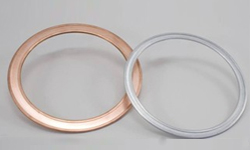
In high-pressure, high-temperature industrial sealing applications, achieving a reliable, leak-tight seal is paramount. This is where Serrated Gaskets excel. Also known as serrated metal gaskets or ring-type joints, these are specialized sealing components designed to create a formidable barrier against the escape of fluids and gases in some of the most demanding environments. Unlike softer, more compressible gasket materials, serrated gaskets utilize a precisely engineered metal-to-metal sealing mechanism. The core of their design features concentric "serrations" or grooves machined onto the sealing faces. When the flange bolts are torqued, these sharp, hardened serrations bite into the softer flange material, creating multiple concentric lines of contact that effectively cold-flow and fill any microscopic imperfections on the flange surfaces. This action results in an exceptionally tight, plastic deformation-based seal that can withstand extreme pressures, thermal cycling, and corrosive media. They are the go-to solution for critical applications in oil and gas, chemical processing, power generation, and high-pressure vessel manufacturing.
The performance of a serrated gasket is dictated by a precise set of specifications. At Kaxite Sealing, we engineer our gaskets to meet and exceed the most rigorous international standards.
The choice of material is critical for corrosion resistance, temperature capability, and mechanical strength. Kaxite Sealing offers a comprehensive range.
| Material Grade | Common Designation | Temperature Range (Approx.) | Key Properties & Typical Applications |
|---|---|---|---|
| Soft Iron | - | -40°C to 540°C (-40°F to 1000°F) | Excellent sealing, good for general hydrocarbon service. Conforms well to flange faces. |
| Low Carbon Steel | A105 / A216 WCB | -29°C to 540°C (-20°F to 1000°F) | General purpose, cost-effective for non-corrosive fluids like steam, oil, and gas. |
| Stainless Steel 304/304L | A182 F304/F304L | -250°C to 800°C (-418°F to 1472°F) | Good general corrosion resistance, used in chemical, food, and pharmaceutical industries. |
| Stainless Steel 316/316L | A182 F316/F316L | -250°C to 800°C (-418°F to 1472°F) | Enhanced corrosion resistance, especially to chlorides and acids. Common for marine and aggressive chemical services. |
| Alloy 20 | UNS N08020 | -45°C to 400°C (-49°F to 750°F) | Excellent resistance to sulfuric acid and other aggressive chemicals. Used in chemical processing plants. |
| Monel 400 | UNS N04400 | -150°C to 600°C (-238°F to 1112°F) | Superior resistance to seawater, hydrofluoric acid, and alkaline solutions. Common in offshore and marine applications. |
| Inconel 600 | UNS N06600 | -150°C to 1100°C (-238°F to 2012°F) | High-temperature strength and oxidation resistance. Used in furnace components, heat treatment equipment. |
With decades of experience in precision sealing solutions, Kaxite Sealing has established itself as a trusted manufacturer of high-integrity serrated gaskets. Our commitment goes beyond simple manufacturing; it's rooted in engineering excellence and quality assurance.
Q: Can a serrated gasket be reused?
A: It is strongly recommended NOT to reuse a serrated gasket. The sealing action relies on the plastic deformation of the serrations as they bite into the flange. Once installed and torqued, the serrations are compressed and have conformed to the specific imperfections of that flange pair. Removing and reinstalling the same gasket will not achieve the same initial bite and seal integrity, greatly increasing the risk of leakage. For safety and reliability, always use a new gasket from a reputable supplier like Kaxite Sealing during any flange reassembly.
Q: How do I choose between an R-type and an RX-type serrated gasket?
A: The choice is primarily dictated by the flange standard and application pressure. R-type gaskets are the standard for ASME B16.5 ring joint flanges. RX-type gaskets are pressure-energized and are typically used with API 6A flanges for wellhead equipment. The RX design can provide a more effective seal at higher pressures and is often interchangeable with R-type grooves, but this must be verified with the flange manufacturer's specifications. Always consult the original equipment drawings or a Kaxite Sealing engineer to confirm the correct type.
Q: What is the proper procedure for installing a serrated gasket?
A: Correct installation is critical:
1. Inspection: Thoroughly clean the flange ring grooves with a brass wire brush, removing all old gasket material, rust, and debris. Inspect grooves for nicks, scratches, or corrosion that could prevent sealing.
2. Lubrication: Lightly apply a high-temperature, anti-seize lubricant (e.g., nickel-based) to the gasket's sealing surfaces. This prevents galling during installation and aids in future disassembly. Do not get lubricant in the grooves.
3. Alignment: Carefully place the gasket into the groove of one flange. Ensure it sits flat and is not twisted.
4. Bolt Torquing: Use a calibrated torque wrench and follow a cross-pattern bolting sequence (star pattern) in multiple incremental steps (e.g., 30%, 60%, 100% of final torque) to apply even pressure across the flange. This ensures the serrations bite uniformly around the entire circumference.
Q: My flange has an oval ring groove. Can I use an octagonal gasket?
A: No. Octagonal and oval ring joint gaskets (and their corresponding flange grooves) are not interchangeable. An oval gasket is designed for an oval groove, and an octagonal gasket for an octagonal groove. Using the wrong shape will not provide the necessary surface contact and will certainly leak. The groove profile is always specified on the flange face. Kaxite Sealing manufactures both octagonal and oval cross-section gaskets to the precise ASME B16.20 dimensions.
Q: How does temperature affect the selection of a serrated gasket material?
A: Temperature extremes influence material selection in two key ways: thermal expansion and strength retention. At high temperatures, materials must resist oxidation (scaling) and maintain sufficient strength (creep resistance) to keep the seal loaded. Alloys like Inconel are chosen for very high temperatures. At cryogenic temperatures, materials must resist becoming brittle. Austenitic stainless steels (304, 316) and certain nickel alloys are commonly used for low-temperature service. Always provide the full operating temperature range, including thermal cycles, when specifying a gasket with Kaxite Sealing.
Q: Are there any special storage or handling requirements for serrated gaskets?
A: Yes. To prevent damage to the精密加工的锯齿面:
- Store gaskets in a dry environment to prevent corrosion.
- Keep them in their original protective packaging until ready for use.
- Handle with clean gloves to prevent skin oils from contaminating the sealing surface.
- Never drop or impact the gasket, as dents or nicks on the serrations will compromise the seal.
- Organize by size and material to avoid mix-ups during critical maintenance operations.

Copyright © 2015-2025 Ningbo Kaxite Sealing Materials Co., Ltd. All Rights Reserved.