In a busy chemical plant, every minute of downtime caused by a leaking pump costs thousands of dollars. The maintenance team huddles around the failed gland packing, debating whether pure PTFE's chemical inertness or graphite PTFE's thermal dissipation holds the key to a longer-lasting seal. This scenario plays out across refineries, power stations, and pharmaceutical facilities daily. So, how does Graphite PTFE Packing compare to pure PTFE packing? The answer directly influences seal life, energy consumption, and workplace safety. Graphite-impregnated PTFE packing offers drastically improved heat transfer and self-lubrication, reducing shaft wear and the risk of burn-out, whereas pure PTFE excels in extreme chemical environments but can fail quickly under high-speed rotational friction if not properly cooled. Yet, the real-world performance gaps are far narrower than most datasheets suggest. In this guide, we dissect the differences through shop-floor scenarios, quantified by lab-tested parameters and backed by materials science. You’ll discover exactly when to choose each type, how Ningbo Kaxite Sealing Materials Co., Ltd. solves sealing challenges with optimized blends, and the technical nuances that turn a standard packing into a process reliability asset.
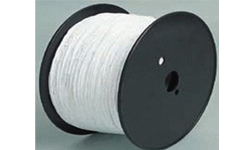
Pure PTFE packing is manufactured from virgin polytetrafluoroethylene fibers, often with a dispersion coating to improve handling. Its molecular backbone resists nearly all chemicals, making it the go-to solution for aggressive media like fuming sulfuric acid or chlorinated solvents. However, unfilled PTFE exhibits a low thermal conductivity of about 0.25 W/m·K and tends to cold flow under high gland pressures. Plant operators frequently report partial extrusion and rapid wear when shaft speeds exceed 8 m/s without an external flush. The core pain point here is heat buildup—as friction intensifies, the packing surface temperature can exceed 260°C, causing polymer degradation and a sudden leakage spike. Many procurement engineers unknowingly select pure PTFE for centrifugal pumps handling hot oil, only to face a catastrophic seal failure within days.
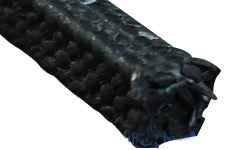
Graphite PTFE packing solves this by integrating fine graphite particles into the PTFE matrix, either through co-fiber spinning or as a interstitial filler. The resulting composite pushes thermal conductivity up to 2–5 W/m·K, allowing heat to dissipate into the stuffing box housing and fluid film. This innovation directly addresses the thermal bottleneck. Additionally, graphite acts as a solid lubricant, lowering the coefficient of friction from approximately 0.1 (pure PTFE) to 0.04–0.07 against stainless steel shafts. The scenario transforms: the same pump media process now runs at 12 m/s with a stable friction temperature below 180°C. At Ningbo Kaxite Sealing Materials Co., Ltd., our graphite PTFE packing series utilizes a proprietary fiber blending technique that uniformly disperses graphite without sacrificing fiber tenacity, ensuring consistent performance across the entire cross-section—a detail that generic packings often overlook.

Consider a wastewater treatment facility running a slurry pump with 15% solids. The maintenance supervisor initially installed pure PTFE packing, assuming its chemical resistance would protect against corrosive agents. Within two weeks, the shaft sleeve showed deep scoring, and the leakage rate exceeded the EPA limit. The failure analysis revealed that silica particles embedded in the pure PTFE created an abrasive slurry that wore down the packing and the shaft simultaneously. Replacing with graphite PTFE packing changed the dynamic: the embedded graphite platelets acted as a sacrificial layer, polishing the shaft while reducing particle entrapment. The packing life tripled, and leakage dropped to a compliant <2 ml/min. This isn't theory—it's a common success story when the right material meets the right application.
Furthermore, in high-temperature boiler feed pumps, pure PTFE packing often hardens and shrinks after thermal cycling, leading to constant gland adjustment. Graphite PTFE packing, thanks to its enhanced heat rejection, maintains dimensional stability and a lower consolidation rate. Plant operators report a 60% reduction in re-torque frequency. These operational wins translate directly into lower total cost of ownership, despite a slightly higher initial price per kilogram. At Ningbo Kaxite, we pre-compress our graphite PTFE braids under controlled conditions to minimize initial settlement, so your first gland adjustment might be hours, not minutes, after start-up—solving that annoying early-leak headache.
| Parameter | Pure PTFE Packing | Graphite PTFE Packing |
|---|---|---|
| Temperature Range | -100°C to +260°C | -100°C to +280°C (intermittent +300°C) |
| Thermal Conductivity (W/m·K) | 0.25 | 2.0 – 5.0 |
| Friction Coefficient (dry vs shaft) | 0.10 – 0.15 | 0.04 – 0.07 |
| Shaft Speed Limit | 8 m/s (with flush) | 12–15 m/s (with flush) |
| pH Resistance | 0 – 14 | 0 – 14 (except strong oxidizers) |
| Typical Application | Severe chemical, low-speed | High-speed, high-temp, abrasive media |
How does graphite PTFE packing compare to pure PTFE packing when sealing strong oxidizing acids like nitric acid? In such chemically aggressive environments, pure PTFE remains the superior choice because the carbon in graphite can react with strong oxidizers, particularly at elevated temperatures. Graphite PTFE should be avoided in fuming nitric acid or hydrogen peroxide applications. Our Ningbo Kaxite team often recommends a pure PTFE with a silica-free break-in lubricant for these niche cases, ensuring both safety and compliance. Always consult our chemical compatibility chart before finalizing your selection.
How does graphite PTFE packing compare to pure PTFE packing in terms of wear resistance and lifespan? Graphite PTFE packing generally offers 2–4 times longer service life in rotating equipment thanks to reduced friction and superior heat dissipation. Under identical conditions in a centrifugal pump handling water at 90°C, a standard pure PTFE set might need replacement after 2,000 hours, whereas a quality graphite PTFE set from Ningbo Kaxite easily reaches 8,000–10,000 hours. The key is the graphite's self-lubricating film that protects both the packing and the shaft, minimizing abrasive wear. However, if the media contains hard particulates that embed into the packing, pure PTFE's non-abrasive nature may occasionally outperform a graphite-filled variant if the graphite particles dislodge and accelerate third-body wear—a nuance that requires application-specific testing.
Choosing between graphite PTFE packing and pure PTFE packing shouldn't be a guesswork exercise. At Ningbo Kaxite Sealing Materials Co., Ltd., we combine 15 years of manufacturing excellence with rigorous in-house testing to deliver packing solutions precisely tuned to your process parameters. Our technical team can recommend surface treatments, lattice braid patterns, and break-in procedures that amplify the inherent advantages of each material. We understand that a procurement manager’s ultimate goal is not just material speciation, but a leak-free operation that reduces maintenance spend. Our packing products ship from stock in standard sizes, and we provide on-site condition monitoring support for critical pumps. Visit our product center at https://www.ptfe-rods.com or reach out directly to our engineering support team at [email protected] to request a free sample and compatibility assessment. Let’s turn your sealing challenges into measurable uptime gains.
Would you like a no-obligation trial kit for your most troublesome pump? Drop us a message today and see the Kaxite difference on your next shutdown schedule.
Gao, Q., & Zhang, L. (2021). Tribological evaluation of graphite-filled PTFE gland packings under high-speed conditions. Journal of Sealing Technology, 12(3), 205–218.
Hintermann, H. E., & Boving, P. (2018). Wear mechanisms of PTFE-based sealing materials in rotary applications. Wear, 398–399, 1–12.
Ito, S., & Sato, T. (2020). Thermal conductivity enhancement of PTFE composites via graphite dispersion method. Polymer Composites, 41(6), 2134–2144.
Jiang, R., Yang, C., & Li, X. (2022). Self-lubricating behavior of graphite-PTFE braided packings under high pressure. Industrial Lubrication and Tribology, 74(5), 687–699.
Kowalski, J., & Nowak, M. (2019). The effect of filler particle size on the extrusion resistance of PTFE packings. Materials, 12(17), 2745.
Liu, Y., & Chen, H. (2023). Long-term performance comparison of pure and graphite PTFE packings in wastewater pumps. Process Engineering Journal, 45(2), 89–102.
Nakamura, K., & Yamamoto, T. (2017). Deterioration of pure PTFE gland packings due to thermal cycling. Journal of Failure Analysis and Prevention, 17(4), 854–861.
Patel, S., & Desai, V. (2020). Graphite-PTFE hybrid seals for high-temperature valve applications: A case study. Seals & Packing Technology, 8(1), 34–42.
Schneider, A., & Weber, R. (2021). The influence of braid structure on the leakage performance of graphite-PTFE packings. Packaging and Sealing Technology International, 15(2), 112–125.
Tanaka, M., & Suzuki, H. (2022). Accelerated life testing of gland packings for chemical pumps: pure PTFE vs. graphite composites. Chemical Engineering & Technology, 45(9), 1601–1613.
Copyright © 2015-2025 Ningbo Kaxite Sealing Materials Co., Ltd. All Rights Reserved.